
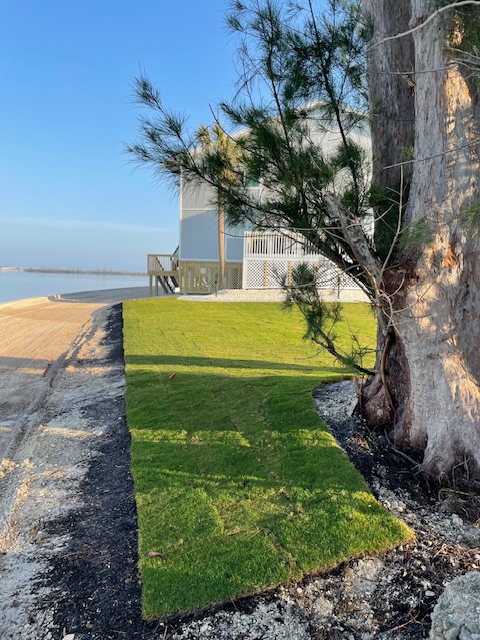
‘UGP 73’ seashore paspalum SeaScape™ : tee-to-green/sports turfgrass with improved drought and shade tolerance.
A vigorous vegetative seashore paspalum, SeaScape™ was developed through 16 years of research by University of Georgia breeders. It produces an excellent quality dense turf unsurpassed in color over a wide range of mowing heights. SeaScape™ is ideal for use on golf courses, athletic fields, home lawns, and other recreational venues as a fine turf. The superior drought tolerance of SeaScape™ was first recognized in evaluations across five southern states through a USDA Specialty Crops Research Grant to develop drought and salt tolerant warm-season grasses. SeaScape™ was the top performing entry in the National Turfgrass Evaluation Program seashore paspalum trials in 2016-2020 and proven to have much improved shade tolerance compared to other paspalums on the market.
Seashore paspalum (Paspalum vaginatum) is a warm-season turfgrass that is particularly well adapted to moist and salt-affected areas common in coastal regions. It tolerates sandy and infertile soils, high salt concentrations, and occasional inundation by seawater, as well as waterlogged conditions. This grass also has many morphological characteristics that make it desirable as a turfgrass.
Seashore Paspalum produces both stolons and rhizomes, has an intermediate to fine leaf texture, an attractive bright green color, good density, and good tolerance to low mowing. Seashore paspalum is considered to be the most salt-tolerant warm-season turfgrass species and also holds great promise for reclamation and soil stabilization of unmanaged salt-affected sites. One of its most unusual attributes is that salt may be used to kill weeds in this grass. For these and many more reasons, we believe that Seashore Paspalum is the future of turfgrass.
BENEFITS OF ‘UGP 73’ seashore paspalum SeaScape™
- Superior drought tolerance
- Excellent turf quality and color
- Incredibly vigorous
- Great turf density and ball support
- Medium-fine leaf texture
- Good dollar spot resistance
- Flexible mowing (wall-to-wall type)
- High salt tolerance
- Better shade tolerance
- Adaptability to soil pH and soil types
- Low water use once established
- Low nitrogen requirements
- Adaptability to water quality, from salty to potable
- Insect resistance (chinch bugs)
- Wear tolerance
- Quick recovery from damage such as divots or cleat tears
- Tolerates a wide range of mowing heights
- Tolerance to low light conditions
- Tolerates the use of salt as herbicide
Where It May Be Used
- Golf Courses
- Sports Fields
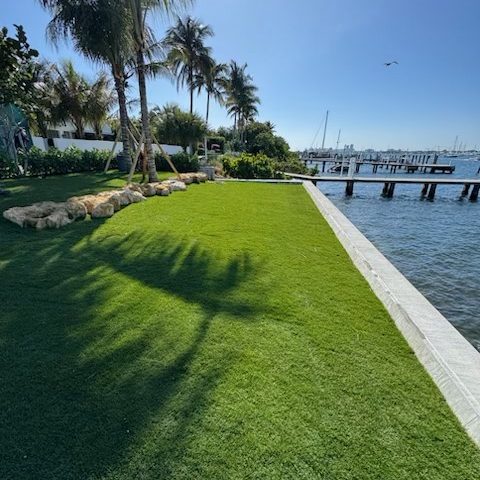
- High-End Lawns
Although seashore paspalum is well-adapted to moist, salt-affected coastal areas, the grass may be planted in nearly any warm-season climate—it has been planted in desert conditions in Egypt and the Middle East; in humid, tropical conditions in SE Asia, Florida and Hawaii; and throughout the warm-season regions of the United States from California to South Carolina. While known for its salt tolerance, salt-affected sites are not required.
Seashore paspalum produces a dense, lush canopy ideal for warm-season golf courses, especially fairways, as its upright nature makes a ball sit up as if on a tee. Some varieties, such as SeaStar, are also well-suited for putting greens use. Seashore paspalum also creates wear-tolerant sports fields because the grass grows aggressively from rhizomes and stolons, making it quick to heal from sports-related wear. While some maintenance characteristics of the grass may not make it ideal for common home lawn use, professionally managed lawns at high-end homes, and especially seaside event lawns at resorts, do particularly well with seashore paspalum grass.
Challenges of Seashore Paspalum
There is no silver bullet, no perfect grass. As versatile as seashore paspalum is, its limitations should be understood. While seashore paspalum may be mowed with a rotary mower, it is prone to scalping and performs best when mowed with a reel mower. This grass grows extremely well in humid climates, but by nature of that climate, paspalum can be prone to diseases that also thrive in moist environs. Chemical treatments are available on the market to treat those diseases.
Perhaps the biggest obstacle to successful seashore paspalum use is removing bermudagrass. No herbicide currently exists that allows 100% control of bermudagrass from seashore paspalum. Therefore, sites previously planted with bermudagrass will invariably have some bermudagrass contamination. While suppression is possible, complete control is extremely difficult. The good news here, though, is that while bermudagrass holds dew in the morning, the leafy nature of paspalum does not. Therefore, bermudagrass contamination is usually only noticeable in the early morning when dew is on the plant.
The UGA seashore paspalum breeding program started more than two decades ago in 1993 at the University of Georgia campus in Griffin. Dr. Paul Raymer assumed the leadership role of the program in 2003. Dr. Raymer leads Team UGA, an interdisciplinary program that brings together the full resources of UGA research. Experts in the fields of entomology, plant physiology, weed science, stress physiology, plant pathology and molecular genetics work together with the goal of developing the finest quality, most environmentally-friendly seashore paspalum cultivars on the market today.
The seashore paspalum breeding program at UGA has released four of the most widely utilized seashore paspalum cultivars: SeaIsle 1, SeaIsle 2000, SeaIsle Supreme and SeaStar seashore pasaplum. With a more than 20-year history of innovation and ground-breaking research coupled with the Team UGA approach to cultivar development, The University of Georgia has the leading seashore paspalum breeding program in the world.